

When to Add More Buildings and When to Stop
One of the biggest turning points for a Lemax collector [...]
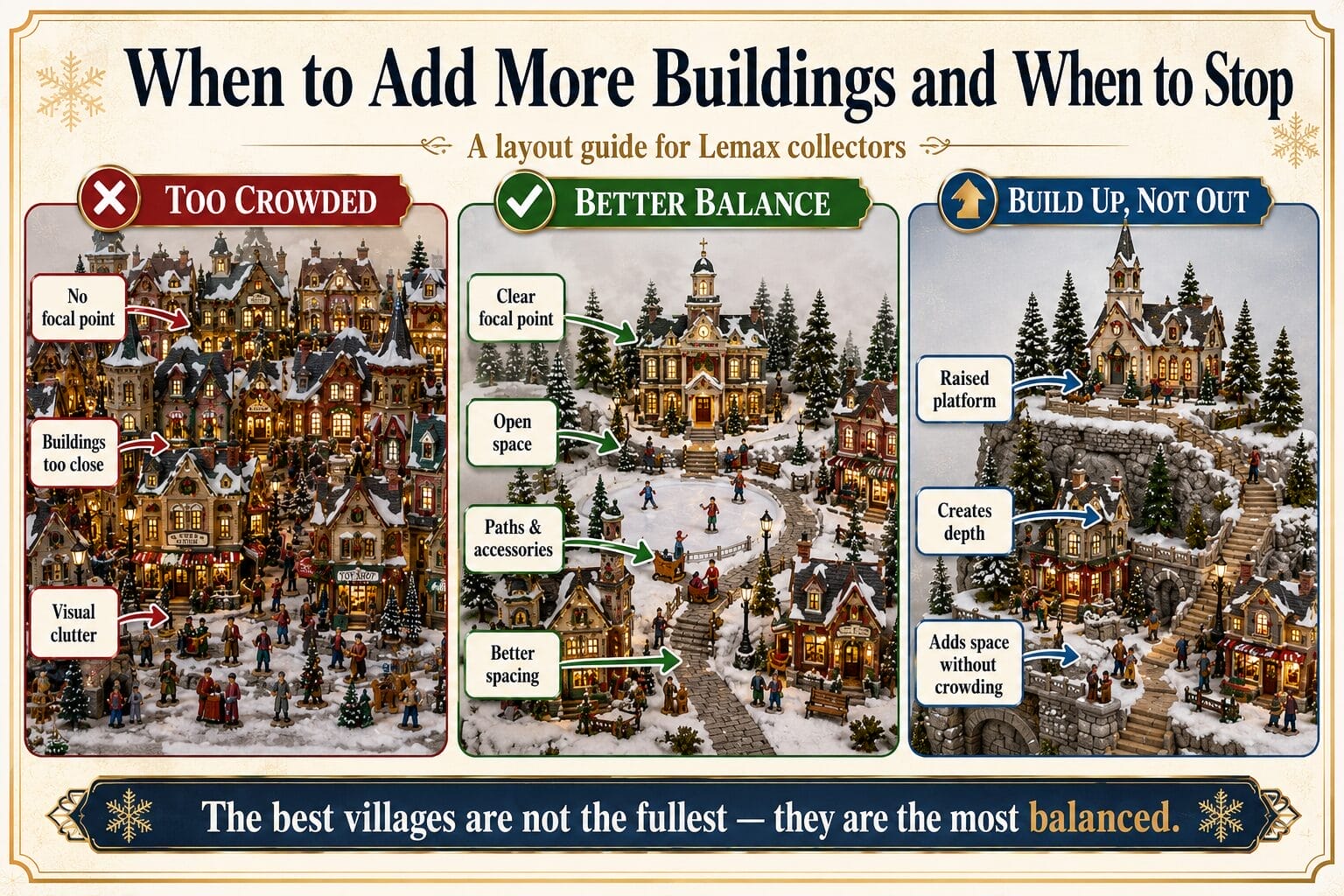
One of the biggest turning points for a Lemax collector is learning that a great village is not built by using every building you own. It is built by choosing the right pieces, placing them with purpose, and giving the scene enough structure so people can actually enjoy what they see. Most collectors start by adding buildings wherever they fit, which is completely natural. The excitement of a new piece makes you want to see it lit up, placed in the snow, and surrounded by figures. But as a collection grows, the challenge changes. The question is no longer, “Can I fit one more building?” The better question becomes, “Will this building make the village stronger?”
That question matters because every building changes the layout. A new piece can complete a street, create a focal point, balance one side of the display, or help tell the story of the scene. It can also crowd the village, block sightlines, compete with better pieces, or make the whole display feel busy. The difference is not always obvious when you are standing close to the table, moving snow around, and trying to make everything work. That is why good village design starts with stepping back and looking at the display as a complete miniature world, not just a collection of individual buildings.
A well-designed Lemax village should have a clear sense of place. It might be a town square, a shopping street, a quiet neighborhood, a mountain lodge scene, a church setting, a train station, or a winter carnival. Whatever the theme, the buildings should feel like they belong together, and the surrounding space should help the viewer understand what is happening. When a village has that kind of structure, even a smaller display can feel complete. When it does not, even a large display with many beautiful pieces can feel crowded and confusing.
Start with the Main Area First
Before adding more buildings, decide what the village’s main area should be. This does not need to be complicated, but it does need to be clear. If the main scene is a shopping street, then storefronts, sidewalks, streetlamps, benches, and people walking from shop to shop will support that idea. If the main scene is a church or town hall, the surrounding area may need more space so the building feels important. If the scene is a neighborhood, houses should have room for trees, fences, walkways, and small figures that make the area feel lived in.
This is where many village layouts go wrong. Collectors often start with the building they want to use and then search for an empty spot. That approach usually results in a display that feels packed rather than planned. A better approach is to begin with the area’s story and then choose the buildings that support it. A bakery is a place where people can gather. A train station needs some arrival space, a path, a road, or nearby travelers. A lodge looks stronger when it has trees, elevation, and a sense of being slightly removed from the busy town. The building should earn its place in the scene.
Once the main area is clear, it becomes much easier to decide what to add and what to leave out. You are no longer judging pieces only by whether they are beautiful. You are judging whether they help the village work as a layout. That is the difference between collecting and designing.
Add a Building When It Solves a Layout Problem
A building is worth adding when it improves the village in a specific way. It might complete a row of shops, create a destination at the end of a path, balance the height on one side of the display, or help connect two sections that feel separate. The best additions usually make the layout easier to understand. When you place the building, and the whole scene suddenly feels more finished, that is a good sign.
For example, a storefront may be the right addition if your shopping street feels too short or unfinished. A small house may help soften the transition between a busy town center and a quieter residential area. A church, school, town hall, or large animated building may work as an anchor if the display lacks a clear focal point. In each case, the building is not just filling space. It is solving a layout problem.
The warning sign is when the only reason for adding a building is that there is still room on the table. Space can feel uncomfortable at first, especially when you have pieces waiting to be used, but space is often what makes the display readable. A gap may actually be the perfect place for a snowy path, a small gathering of figures, a tree line, a fence, a bench, or a platform transition. If another building does not improve the scene, it may be better to save it for a future layout.
Stop When the Village Loses Focus
A village is getting too crowded when the best pieces stop standing out. Most displays need one or two main focal points. That might be a church on a hill, a large animated building, a town square, a train station, or a dramatic storefront. The rest of the village should support those areas rather than fight them. When too many buildings are placed close together, especially if they are all bright, tall, detailed, or animated, the viewer’s eye has nowhere to rest.
This is why stepping back is so important. A layout may look fine when you are focused on one small area, but from across the room, it may read as a wall of lights and rooftops. Stand back and ask where your eye goes first. If the answer is unclear, the village may need fewer buildings, better spacing, or a stronger focal point. A good display leads the viewer through the scene. It does not make them work to understand it.
This is especially true with larger Lemax pieces. Big animated buildings, churches, town halls, and dramatic centerpieces need more breathing room than smaller shops or houses. If too many surrounding pieces crowd them, they lose the importance they were meant to have. Giving a major piece of space around it is not a waste of room. It is allowing that building to do its job.
Open Space Is Not Empty Space
Open space is one of the most important tools in village design. It gives the display breathing room, makes the main buildings easier to see, and creates places for roads, paths, figurines, trees, and scenery. Without open space, everything becomes visual noise. The windows glow, the rooftops overlap, the figures disappear, and the village starts to feel like storage instead of storytelling.
In a real town, every inch is not covered by buildings. There are streets, sidewalks, courtyards, yards, parks, bridges, and quiet corners. A Lemax village feels more believable when it has those same kinds of spaces. A snowy walkway between two buildings can be just as important as the buildings themselves. A small open area in front of a church can make the church feel important. A road leading to a train station makes the station feel connected. These spaces help the viewer imagine how people move through the village.
Open space also lets accessories matter. Trees, fences, benches, streetlamps, signs, bridges, walls, snowmen, and figurines are not just decorations at the end. They are part of the design. They connect the buildings, control the flow, and make each area feel intentional. Many displays do not need another building as much as they need stronger use of the space between buildings.
Use Accessories Before Adding Another Building
When a village feels unfinished, the first instinct is often to add another structure. In many cases, the better answer is to improve the scene around the buildings you already have. A building standing alone can feel disconnected, but the solution may be a path to the door, a few figures nearby, a lamppost, a fence, a tree, or a small scenic detail that gives the piece context.
Accessories help explain what is happening. A group of villagers outside a bakery makes that area feel active. A bench and streetlamp can turn a plain snowy corner into a quiet resting spot. A fence can define a yard. A bridge can connect two areas. Trees can separate a busy town from a quieter residential section. These details are what make a village feel alive instead of arranged.
This is also where collectors begin moving from a beginner setup into a stronger design. At first, the buildings get most of the attention because they are the largest and most exciting pieces. Over time, you realize the accessories are what make the layout believable. They are not filler. They are the glue that holds the scene together.
Build Up When You Cannot Build Out.
If table space is limited, adding more buildings side by side usually makes the village feel crowded. A better solution is often to build upward. Raised platforms, landscape bases, hills, stairs, bridges, retaining walls, and layered sections can give the village more depth without forcing every building onto the same flat surface.
Height is one of the strongest design tools in a Lemax layout. A flat display can look like a row of pieces on a table, even when the buildings are beautiful. Adding elevation creates depth, separates scenes, and gives important buildings a stronger presence. A church, lodge, town hall, castle, or major animated building can look much more impressive when placed on a raised area with steps, trees, rocks, or a path leading up to it.
A raised platform also helps when space is tight. Instead of squeezing another building into an already crowded street, you can move that piece slightly higher and farther back, creating the feeling of a second level. The lower area can accommodate shops, figurines, roads, and smaller details, while the raised area serves as a separate destination. This makes the village feel larger without feeling packed.
The key is to make the height change look intentional. A platform should not look like a random box placed behind the village. It should feel like part of the landscape. Use snow, stone walls, trees, stairs, bridges, fences, or pathways to connect the upper and lower levels. If people can visually understand how villagers would move from one level to the next, the raised area feels natural. If there is no connection, it can feel separate from the scene.
Landscape platforms are especially useful for collectors who want to include more pieces without making the village look stuffed. They create separation, improve sightlines, and allow buildings in the back to be seen instead of hidden behind the front row. They also create opportunities for small scenes: a couple walking up steps to a church, children playing near a hillside, a sleigh path leading to a lodge, or trees wrapping around a raised town square. When used well, height adds more than space. It adds design.
Rotate Pieces Instead of Forcing Everything In
As your collection grows, there will come a time when not every building can be used in one display. That is not a failure of design. It is part of collecting. Trying to force every piece into the village usually weakens the layout, even if each building is beautiful.
Rotating pieces from year to year keeps the hobby fresh and gives your best buildings room to shine. One year, you may build a cozy town center. In another year, you may focus on a lodge scene, a carnival, a train station, or a residential street. Pieces that do not fit this year can become the stars of a future display. This approach also makes setting up the village more creative because you are not locked into the same overcrowded arrangement every season.
Leaving a building in the box does not mean it is less important. It means the display has been edited. Good design requires choices, and sometimes the strongest choice is knowing what not to use.
The Simple Test Before Adding More
Before adding another building, place it in the display and step back. Look at the entire village, not just the empty spot you are trying to fill. Ask whether the building improves the scene, creates better balance, strengthens the focal point, or helps the layout make more sense. If it does, keep it. If the village looks only fuller, not better, the piece probably belongs somewhere else.
Also, ask whether the space would be stronger with accessories instead of another structure. A path, platform, tree line, bench, fence, or group of figurines may solve the problem more elegantly than another building. The best layouts usually come from a mix of buildings, scenery, height, and open space. When those parts work together, the village feels complete without feeling crowded.
Final Thought
The best Lemax villages are not the ones with the most buildings. They are the ones where each piece has a purpose, each important building is visible, and the entire scene feels connected. Adding more buildings can be exciting, but the real skill is knowing when another piece helps the design and when it starts to weaken it.
This is a good lesson to end the beginner series with because it prepares collectors for the next stage of layout design. Once you understand how to choose buildings, leave breathing room, use accessories, and build height into the display, you are ready to think more deeply about focal points, pathways, sightlines, lighting, and depth. That is where a village starts to move beyond setup and becomes a true miniature world.
Share This Story, Choose Your Platform!
Follow us
Latest articles

September 1, 2026

August 10, 2026

July 20, 2026

July 2, 2026

June 19, 2026